Tuesday, 8 March 2016

Hair Technical File- modern interpretations of 50’s, 60’s and 70’s

                     1960's 
Equipment:

  • paddle brush 
  • pintail comb
  • heated rollers
  • clips
  • hairspray
  • grips
Firstly Lottie gave us a demonstration of different styles and what we can create with the choice of the different decades. After looking at images online I decided to go with the 1960's and create a bouffant style with a quiff giving the hair a lot of volume. 

  1. I started with getting the rollers out and plugging them in and getting them heated up ready to use. Once they were hot I brushed through the hair and sectioned the top part ready for the rollers. Since I was creating a quiff at the front I needed the direction of the rollers all going backwards in the direction that I want the hair. 
  2. I used the red rollers for the top section as they are the largest ones to create volume for the particular style I want. I then put three red rollers face backwards down the center of the head and clipped them in place. 
  3. I then started on the side section of the head where I used blue rollers which are slightly smaller at the front of the head all facing backwards creating brickwork pattern. 
  4. At the back of head where the crown is this is where I want the most volume so I used red rollers at the back and the sides of the head. 
  5. When I got to the last part at the bottom of the head I went back to blue rollers to give a tighter curl at the bottom. I placed the rollers all in the direction I wanted the hair to go and used the size according to the lift and curl size. As I didn't want curls I wanted more volume and body throughout the hair I used the largest rollers. 
  6. I then waited for the hair to cool down and finally started taking all the rollers out of the hair. 
  7. Once all the rollers where out I brushed through the hair once and then used my comb to started back combing from the top to the back giving the hair more volume. 
  8. I then section the front off with my pintail comb for the quiff, once I had a section large enough I back combed the section of hair and then placed it where I wanted it and gripped it down. I then went back to the top of the hair where  want the most volume and back combed the crown section.
  9. Finally I went all over with the hair spray to set the look and quiff. 


Evaluation 

Over all I think the style came out very well with the volume I needed throughout the hair. I was pleased with the outcome of the rollers as it gave the hair the direction and lift I needed to execute the look. If I could do it again I would try it on a real head instead of the Kate head to see if the style looks any different, I also would of preferred if the hair was a little bit longer because its quite short so does effect the look overall. As when giving the hair volume and lift the hair shortens anyway so I would of preferred longer hair. The rollers gave me the wave I needed as I didn't want the hair curly it was more about the volume. I think I still need more improvement with rollers which will come with more practice when creating styles because I need to get the hang of putting them in securely clipped without any drag. 

| FINAL LOOK |


Health and Safety:
  • Do not run in the studio
  • Be careful with hot equipment such as heated rollers
  • Be careful with trailing wires
  • Keep bags and coats away from work area
  • keep work area neat ad tidy


Monday, 7 March 2016

Make-up Technical File- Catwalk contour: highlighting, contouring and blushers

Contouring


Products:
  • simple face moisturiser 
  • Laura Mercier Primer
  • Collection Illuminating touch brightening concealer
  • Nars concealer vanilla 
  • maybelline dream satin liquid 60. caramel
  • Ben Nye banana powder 
  • Illamasqua duo sculpting powder and highlighter
  • MAC highlighting pink nude powder 
  • Estee Lauder bronze goddess medium
First step was making sure the face is nice and clean and hydrated ready for the application of make-up.

  1. Firstly I applied primer all over the face, I then used brightening concealer under the eyes and on the lids.
  2. Next was concealing certain areas, I used it under the eye again, middle of the forehead, under the cheekbones, centre of nose and on the chin. I then used a dark foundation called dream satin liquid and contoured certain areas which were top of the forehead and sides, cheekbones, jaw line and chin and nose. Using my Real Technique blending brush I blending it all into the face working in circular motions and also down the neck. 
  3. I set the look using the Ben Nye banana powder, I then used bronzer on the forehead, cheeks and neck to contour slightly. To contour further I used Illamasqua sculpting powder on the cheekbones to define them more. To give warmth to the cheeks I applied MAC nude pink powder on the apples of the cheeks. 
  4. Finally I used a highlighter at the top of the cheekbones, down the nose, forehead, top lip and chin. 


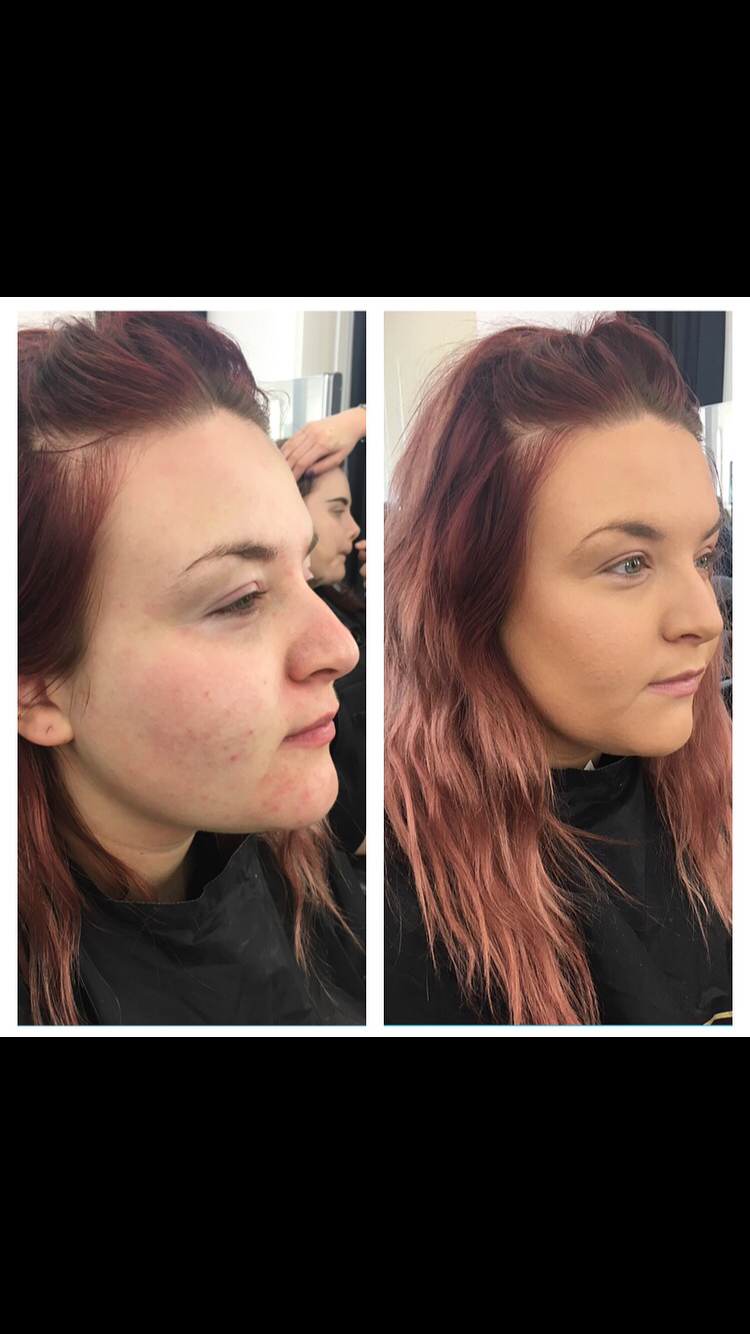
My model has a skin condition where she has quite prominent white patches around her eyes and she finds it very hard to conceal. I tried my best to conceal it and create a flawless finish to the skin with highlight and definition. 

Evaluation
I think the overall finish of her skin looked really good and I was happy with the outcome. I think the hardest part was to conceal around the eyes however felt I succeeded with covering it. I think if I could do it again I might try and create more of a dewy contoured look with lots of highlighter as I went slightly more matte with this look. I think if I would improve on the look I would say I went a little too dark for her natural skin colour. When colouring I probably need to use more of the light shade than the dark otherwise the whole face can come out too dark for her natural skin colour. I think the skin does look glowing and flawless and I'm pleased with the outcome of my catwalk contour. 


Contouring: an outline representing or bounding the shape or form of something.
It is the edge or line that defines a shape/object.
Sculpt: to form, shape or manipulate or other shaping techniques
Correct: remove the errors from
Highlight: a bright or reflective area in a painting, picture or design

Why do we contour: To bring colour and natural shadows back to the face, to look better.

Products/textures:
Cream contouring:
If you don't want to achieve a complete matte finish with all powder then use cream/wet products to contour, illuminators, strobe liquid not contour powders.
(Experiment and add eyeliner and foundation together to create a cream texture) - experiment with cream contouring using foundation creams/liquids and concealers to do your base before adding further depth and defined shape.
Powder contouring:
Powder/set a foundation base, before you add any shape to the face using contour powders on top for any more sculpting so it blends well and is smooth, rather than applying contour powders straight on to a foundation base.

Think about the colour of the products you're using:
Look at the light/darkness of the shade, highlight a few shades lighter than the models skin match and to add depth and shadow use a tone a couple of shades darker than the skin base.
How does it appear on the skin? Examine the natural shade tone of the model and re create this tone. You can see the natural contour of the face - the jaw outline for example.

Look closely into the undertones of a colour, has it got yellows, pinks, greys in it (light, medium, dark tones). Look at colour theory, get a colour wheel from an art store in your kit and understand lightness and darkness - compared to the natural shadow tones of someone's face.

Understanding the colour of natural shadows on the face for different skin tones is important. Areas on the face will be lighter than other darker areas/shadows - you will sometimes require more than one light shade and one dark shade for highlighting and contouring to add this depth and shade. Develop your contour images - start basic with natural contouring, then add more depth and sculpture to the face. Know the purpose of contouring you are setting out to achieve, how much do you want to shape and outline the face? What's the purpose of the job? Editorial? Bride? Celebrity?

Tip: Contrast in photo edit/Instagram/photoshop - notice in a portrait headshot the light parts get much lighter and the shadows/hollows of the face get much darker. Understand your face shape, look at these shadows and tones which shape the face.

Matte or Cream: Quality of the product is important when contouring (smoothness, feel of the product, the tone, the movement and colour difference. Compare these creams and powders and see what you like to work with to contour and highlight.

Bronzers/Shimmer: to add glow, tan, a sun kissed warmth, these can also be shimmery so don't use bronzers as contour shading powders as shimmery products reflect light - bringing it forward, not back.

Evaluate face shapes for contouring (not just face features) examine jaw lines and hair lines - these create different contour outlines of the face, cheek shapes/propionate or no cheekbone structure - observing the bone structure/low or high cheekbones/shape of the bridge of the nose/rounded, pointed or flat chin. Move the face to the side to see the profile of the face, low or high cheekbones/jaw lines/nose shapes/chin shapes. Look at the parts of the face that move forward (naturally catching the most light) so you know where to contour.


Monday, 15 February 2016

The Contoured Face


The Right Way to Contour for Your Face Shape

By Brooke Shunatona
Jul 24, 2015

Contouring and highlighting are like chocolate syrup and vanilla ice cream: best together. First, let's review these makeup techniques before getting into the mind-blowing contouring maps that follow.
Contouring is when you use a matte (read: not shimmery) powder, cream, or pencil product that's two shades darker than your skin tone to shade areas you'd like to define or reshape, like your nose, forehead, chin, and cheekbones.
Highlighting (or strobing) offsets contouring by accentuating areas of your face with light concealer or highlighter. To properly highlight or strobe, use a concealer that's two shades lighter than your skin tone or a highlighter that flatters your complexion to emphasize the areas of your face that naturally catch the light.

For Example:

DIAMOND FACE SHAPE

How to tell if your face is shaped like a diamond:
  • Your hairline is more narrow than your cheeks.
  • Your chin is slightly pointed.
  • Your face is longer than it is wide.
Where you should contour:
  • The area below your cheekbones starting from your ears and ending in the middle of your cheeks.
Where you should highlight:
  • Under your eyes in an upside-down triangle shape and along your brow bone to brighten your eyes.
  • In the middle of your forehead and the middle of your chin to help broaden these naturally narrow areas.
http://www.cosmopolitan.com/style-beauty/beauty/how-to/a43730/face-shape-contour-map/

In the last year contouring has been huge and the media has gone crazy for it and finding out how to do it. Contouring is the use of dark and light colours which contrast on the face to create certain features to pop out and certain features to appeal more sunken in for depth on the face. Using highlighters on the face can help highlight points, you can either cream/liquid contour on the face or you can powder contour with different coloured powders or for a dramatic look do both! In our upcoming lesson we are learning highlighting, contouring and blushers. 

The 10 most iconic faces of Chanel

The 10 most iconic faces of Chanel

Stylist 
http://www.stylist.co.uk/fashion/the-10-most-iconic-faces-of-chanel#


Catherine Deneuve

Brand: Chanel no.5

Date: 1965-76

Screen siren Catherine Deneuve became the first actress to represent Chanel No.5 when artistic director Jacques Helleu decided to overhaul the brand's image and give the scent a more alluring appeal. The campaign included a series of iconic mini-videos shot by Ridley Scott over the late seventies.


Claudia Schiffer

Brand: Chanel Boutique, Cristalle and Eyewear

Date: 1987 - 2011

Becoming the face of Chanel in 1987 was supermodel-in-the-making Claudia Schiffer’s big break. And she's still going strong 20 years later, most recently fronting the 2011 campaign for Chanel's new range of eyewear


Linda Evangelista and Christy Turlington

Brand: Chanel Boutique

Date: 1991

Linda Evangelista and Christy Turlington were two of the most iconic models of the Nineties. Their combined glamour and effortless cool made them the perfect choice to front the brand's boutique clothing range.


Stella Tennant

Brand: Chanel Boutique

Date: 1996 - Present

Stella Tennant’s masculine look first caught the eye of Karl Lagerfeld when she appeared on the cover of ItalianVogue. She became the face of Chanel in 1998 and has remained a muse of Lagerfeld’s ever since.


Kate Moss

Brand: Coco Mademoiselle Chanel

Date: 2001 - 2005

No fashion history is complete without the inclusion of Miss Moss. Despite being the face of Coco Mademoiselle Chanel since its launch in 2001, after five years Kate was swiftly replaced by Keira Knightley amid rumours of hardcore partying.


Nicole Kidman
Brand: Chanel No.5


Date: 2004

Nicole Kidman was the star of Chanel’s 2004 campaign, including a famed four-minute mini-film shot by Baz Lurhmann. Costing an astonishing £18 million to produce, the film later won a Guinness World Record for being the most expensive advert of all time.


Jerry Hall

Brand: Chanel Accessories

Date: 2009

Back in 2009 a 52-year-old Jerry Hall proved age is just a number when she fronted a seriously seductive campaign for Chanel's accessories line. In Karl Lagerfeld's words: "Oscar Wilde said, 'I like men who have a future, and women who have a past.' It is this whole idea of seduction that is summarised here that appeals to me."


Audrey Tautou

Brand: Chanel No.5

Date: 2009

After playing Coco Chanel herself in the 2009 hit film Coco Before Chanel, Audrey Tautou was a shoo-in to become the new face of Chanel No.5. Joining forces with Amélie filmmaker Jean-Pierre Jeunet, she starred in an advert released on 5th May, 88 years to the day after Coco Chanel first produced her iconic fragrance.


Brad Pitt

Brand: Chanel No.5

Date: 2012

Hearts across the country skipped a beat when Brad Pitt became the first ever male face of Chanel No. 5, starring in a black and white video that has been watched over 8 million times on YouTube. 


Marilyn Monroe

Brand: Chanel No.5

Date: 2012

Marilyn Monroe's love of Chanel No.5 was no secret. And it is now possible to hear, for the first time, a rare recording of the Hollywood star admitting she wears “just a few drops of Chanel No. 5” to bed, in a new video for the perfume.


Gisele Bündchen 


Supermodel Gisele Bündchen has been announced as the new face of Chanel No. 5.

As shooting of the extravagant advert - or mini film - by Baz Luhrmann begins with the Brazilian star, we look at 10 of the most iconic faces of Chanel so far, from Catherine Deneuve to Kate Moss.
Another very familiar face for Chanel was actress Keira Knightly. The faces of Chanel become big and are beautiful elegant women who portray the brand perfectly.


http://www.celebrityendorsementads.com/celebrity-endorsements/
celebrities/keira-knightley/images/keira-knightley-chanel-coco.jpg

Keira On Coco


  • 26 JANUARY 2011
  •  by
  • Ella Alexander

KEIRA KNIGHTLEY admits she had concerns about becoming a Chanel ambassador. The actress is currently the face of its Chanel Mademoiselle perfume campaign.

Describing her own style as "scruffy", the Never Let Me Go star confesses she doesn't like dressing up for red carpet events too often.

"As long as I do it rarely, then I enjoy it," she says. "It's nice to have an occasion to wear a silly frock and get dolled up but I'm not really that sort of person."

http://www.vogue.co.uk/news/2011/01/26/keira-knightley-on-being-a-chanel-star


Friday, 12 February 2016

Chosen Make-up Brand- CHANEL


Coco Chanel Biography

(1883–1971)
With her trademark suits and little black dresses, fashion designer Coco Chanel created timeless designs that are still popular today.

Synopsis

Fashion designer Coco Chanel, born August 19, 1883, in Saumur, France, is famous for her timeless designs, trademark suits and little black dresses. Chanel was raised in an orphanage and taught to sew. She had a brief career as a singer before opening her first clothes shop in 1910. In the 1920s, she launched her first perfume and eventually introduced the Chanel suit and the little black dress, with an emphasis on making clothes that were more comfortable for women. She died on January 10, 1971.

Fashion and Fragrance Pioneer

Around the age of 20, Chanel became involved with Etienne Balsan, who offered to help her start a millinery business in Paris. She soon left him for one of his even wealthier friends, Arthur “Boy” Capel. Both men were instrumental in Chanel’s first fashion venture.

Opening her first shop on Paris’s Rue Cambon in 1910, Chanel started out selling hats. She later added stores in Deauville and Biarritz and began making clothes. Her first taste of clothing success came from a dress she fashioned out of an old jersey on a chilly day. In response to the many people who asked about where she got the dress, she offered to make one for them. “My fortune is built on that old jersey that I’d put on because it was cold in Deauville,” she once told author Paul Morand.

In the 1920s, Chanel took her thriving business to new heights. She launched her first perfume, Chanel No. 5, which was the first to feature a designer’s name. Perfume “is the unseen, unforgettable, ultimate accessory of fashion. . . . that heralds your arrival and prolongs your departure,” Chanel once explained. The fragrance was in fact also backed by department store owner Théophile Bader and businessmen Pierre and Paul Wertheimer, with Chanel developing a close friendship with Pierre. A deal was ultimately negotiated where the Wertheimer business would take in 70 percent of Chanel No. 5 profits for producing the perfume at their factories, with Bader receiving 20 percent and Chanel herself only receiving 10 percent. Over the years, with No. 5 being a massive source of revenue, she repeatedly sued to have the terms of the deal renegotiated. 

Suit and Little Black Dress

In 1925, she introduced the now legendary Chanel suit with collarless jacket and well-fitted skirt. Her designs were revolutionary for the time—borrowing elements of men’s wear and emphasizing comfort over the constraints of then-popular fashions. She helped women say goodbye to the days of corsets and other confining garments.

Another 1920s revolutionary design was Chanel’s little black dress. She took a color once associated with mourning and showed just how chic it could be for evening wear. In addition to fashion, Chanel was a popular figure in Parisian literary and artistic worlds. She designed costumes for the Ballets Russes and Jean Cocteau’s play Orphée, and counted Cocteau and artist Pablo Picasso among her friends. For a time, Chanel had a relationship with composer Igor Stravinsky.

Legacy

In 1969, Chanel’s fascinating life story became the basis for the Broadway musical Coco, starring Katharine Hepburn as the legendary designer. Alan Jay Lerner wrote the book and lyrics for the show’s song while Andre Prévin composed the music. Cecil Beaton handled the set and costume design for the production. The show received seven Tony Award nominations, and Beaton won for Best Costume Design and René Auberjonois for Best Featured Actor.

Coco Chanel died on January 10, 1971, at her apartment in the Hotel Ritz. She never married, having once said “I never wanted to weigh more heavily on a man than a bird.” Hundreds crowded together at the Church of the Madeleine to bid farewell to the fashion icon. In tribute, many of the mourners wore Chanel suits.

A little more than a decade after her death, designer Karl Lagerfeld took the reins at her company to continue the Chanel legacy. Today her namesake company is held privately by the Wertheimer family and continues to thrive, believed to generate hundreds of millions in sales each year.

In addition to the longevity of her designs, Chanel’s life story continues to captivate people’s attention. There have been several biographies of the fashion revolutionary, including Chanel and Her World (2005), written by her friend Edmonde Charles-Roux.

In the recent television biopic, Coco Chanel (2008), Shirley MacLaine starred as the famous designer around the time of her 1954 career resurrection. The actress told WWD that she had long been interested in playing Chanel. “What’s wonderful about her is she’s not a straightforward, easy woman to understand.”

http://www.biography.com/people/coco-chanel-9244165#legacy


| LABEL OVERVIEW |

Chanel is one of today’s best known and most highly sought-after fashion brands, and has been one practically since it was founded by Coco (Gabrielle) Chanel in 1909. Her big break hit when she opened a small shop in Paris in 1910 where she sold her hats. And by 1913, after asserting disdain for resort wear, she launched sportswear: Her take was simpler—flannel blazers, jersey sweaters, and women in trousers, all of which were decidedly against twentieth-century culture memes. Chanel was trendsetting before there were trends. Her post–World War I look gained attention, as she brought on modernism in fashion through beaded dresses in the twenties, the infamous little black dress, as well as a two- or thee-piece suit, which is still a signature Chanel look. By 1921 she introduced Chanel No. 5, and was once quoted as saying "A woman who doesn't wear perfume has no future." No. 5 went on to become one of the best-selling fragrances of all time. After a period away from Paris, Chanel returned after the Second World War in the fifties, a time when Christian Dior was touted as Paris's premiere couturier. However, Chanel rose again with the launch of her chain-link belt and quilted leather bags—today with the interlocking C's—reestablishing Chanel as the definition of classy glamour with an edge. Coco passed in 1971, but the brand continued, even launching their first ready-to-wear collection in 1978. Yet without a lead designer to be the face of the brand, the house struggled to maintain its enchanting reputation for luxury. That is, until Karl Lagerfeld joined in 1983 to revive it to its elite status, which he did with added glamour and sexiness. Today, Chanel stands out in just about every category—couture, ready-to-wear, accessories, jewellery, shoes, and fragrances. What began as a no-nonsense approach to fashion, designed to let women be comfortable while looking dignified, has been translated into classic, tailored style, especially in ready-to-wear, where the traditional tweed Chanel suit with a nipped-at-the-waist cardigan jacket remains one of the most popular—and most copied—fashion staples. Evening gowns tend to have an understated sex appeal and a bit of whimsy, and appear in luxurious fabrics with lots of embellishments. Yet, there is always an undeniable element of the house's founder. "A girl should be two things: classy and fabulous," Coco Chanel once said. Fitting, since that's the absolute embodiment of the label even a century after it was founded.

DESIGNED BY Karl Lagerfeld, 1983 - Present; Yvonne Dudel, 1978 - 1983; Jean Cazaubon, 1978 - 1983; Philippe Guibourge, 1978 - 1983

http://nymag.com/thecut/fashion/designers/chanel/

AN OVERVIEW OF CHANELS CATWALKS, ADVERTISING AND EDITORIAL...

CHANEL CATWALK MOOD BOARD


CHANEL ADVERTSING MOOD BOARD


CHANEL EDITORIAL MOOD BOARD


The 5 P’s – Product, Packaging, Presentation, Promotion and Price Point...
This unit I will be in depth studying Chanel's brand overall and looking at the five P's. This will also include the beauty part of the unit where I will be studying the trends, designers, S/S 16, the influence and also reference my research to my final images. The mood boards I created above are photos by Chanel and each mood board represents what we have to create for our final images. The whole brief is based on creating S/S 16 and creating two looks for a Chanel catwalk, two for advertising which we can base it round a product and two for editorial which can be made into a double page spread for a magazine. I created three mood boards which have given me a basic idea of what the brand Chanel creates for advertising, editorial and on the runway. When I have narrowed my idea down further I will start creating face and hair charts and create mood boards for each shoot and what the overall look and theme will be. 

MAKEUP


FRAGRANCE


SKIN CARE


JEWELLERY
FINE JEWELLERY

WATCHES

FASHION 
COLLECTION


BAGS

SUNGLASSES


ACCESSORIES
SMALL LEATHER GOODS

SHOES

CAMELLIAS

SCARFS 
HATS
GLOVES
http://www.chanel.com/en_GB/